Things I learned at WisCon39…

…About Tales of MU

First of all, there was a conversation I kept having around the subject of Tales of MU, involving people who were either lapsed readers or current readers who were far behind. Someone would ask me how often I update it, and I would say, apologetically, that I try for more, but just lately it’s been one a week most weeks.

And the response would be something like, “Oh, good, maybe I’ll start reading/catch up.”

I’ve always seen frequent updates as a key to maintaining an audience and also making sure I’m giving sufficient value for my readers’ money, but after the third time I had a conversation like that, I started to wonder if my sense of “frequency” isn’t calibrated a little high. I am an unusually fast reader, after all.

I’ve been thinking about the value I give my readers, but I hadn’t given much (or any) thought to the time investment being a reader requires of them. Maybe having 6,000-9,000 words of new story a week is too high an “engagement cost” to most readers, compared to 2,000-3,000.

So, as an experiment, I’m going to be dialing it back to once a week, intentionally. I know I’ve done this before, but always for internal reasons. Here I’m going to have a mixture of internal and external. The current book is already intended to be a good jumping-on point for new readers, so I’ll also point it out to former readers looking to ease back in without having to archive binge first if that’s not their thing. We’ll continue onward at the relatively gentle pace of one chapter a week… though not this week. My travel misadventure plus (ongoing) sickness has not given me much in the way of creative time or energy.

Second, it’s striking how frequently readers I meet in person mention how hot/well done the sex scenes are. This is something I have a great deal of insecurity/uncertainty about. The idea of writing straight out erotica with the MU characters/in the MU world (as in stand-alone shorts that don’t need to be understood in the context of the larger story) is one that is evergreen, but one that I’ve never quite been able to pull off… but I feel like there could be interest (and thus money) there.

Third, even people who have drifted away from or outgrown the series appreciate it. Multiple individuals told me words to the effect that the story was there for them when they needed it or taught them something that they needed to know. That’s a good feeling.

…About Myself

First, I am much better at moderating panels than I am at moderating forums or comments sections. I was assigned to moderate one of the panels that I was on, which gave me some concern as I’ve never counted moderation as being within my skillset. It actually went fairly smoothly, with some understandable first time hiccups that didn’t seem as noticeable to anyone who talked to me about it afterwards, and next year I intend to actually put myself forward as a moderator.

Second, I am getting much better at recognizing people. Frankly, I think this is partially down to going to WisCon every year, but I think Tumblr deserves a little bit of the credit.

…About Life

My first panel of the weekend was on the subject of managing canon, how much one cares about maintaining strict continuity. I may make a blog post summing up my feelings on this later, if I still feel like doing it when I have a more orderly brain, but one thing that came up in the panel that was sort of a theme for me for the rest of the con was the idea that we are not the same people who wrote our first books/earlier works.

And this helped slot some things into place that I’ve been trying to get a handle on in my personal life, where I spent about five years trying to live my life in a holding pattern and have been having a hard time shifting out of that. I think the major problem there is that I can’t go back to who I was in 2009 and hit resume, which is what I’ve been trying to do.

…About WisCon

As (WisCon 39 Co-Chair) Mikki Kendall has noted, the situation was never quite as dire as the mythmaking has made it out to be. WisCon 39 was always going to happen as long as enough people were willing to make it happen. Of course, “enough people” is a slippery concept… we really need to better distribute the load for next year.

While many people are understandably disappointed in some of the decisions that were made during the transition between the old guard and the new, the quiet efficiency with which certain problems were handled this year speaks to a more pro-active and nimble approach to things that I think will make for a safer and more pleasant convention all around. Many people I spoke to noted a change in the atmosphere that was hard to define, but welcome.

I don’t know. I left very hopeful for the future of WisCon. I didn’t do as much to support WisCon 39 as I’d wanted to, partially because my life was bumpy in unexpected ways but also partially because I think I misjudged where I could most easily make the largest contributions. Knowing better where my skills are needed is going to let me contribute much more to WisCon 40.

Hello, WisCon people!

Meeting people at WisCon is always interesting. There are people I know or have seen around online for years but only see in person every year or less. Prosopagnosia (face blindness) means that it doesn’t always penetrate when I have met someone before. Each year there’s a few people I have the mildly embarrassing experience of not quite remembering, but at least the WisCon crowd is pretty forgiving about that kind of thing.

This year was a little more interesting because I made a splash with something (my Sad Puppy Book Reviews) in the weeks immediately before the con, so it seemed like there were a lot more people who knew my name or had a touchstone for my work.

The main purpose of this message is to address the people who are looking me up after getting home. I had meant to put up something like this a lot sooner after the con, but… travel woes, then sickness.

First, let me say that if you just found about me and you want to know what else I do besides Puppy parodies and WisCon panels, I’ll direct you to my about page, which has some links to quite a bit of my work that’s available for free. The sidebar of this blog also has stuff you can buy. If you want to keep up with everything I do while also giving some support, I recommend my Patreon page.

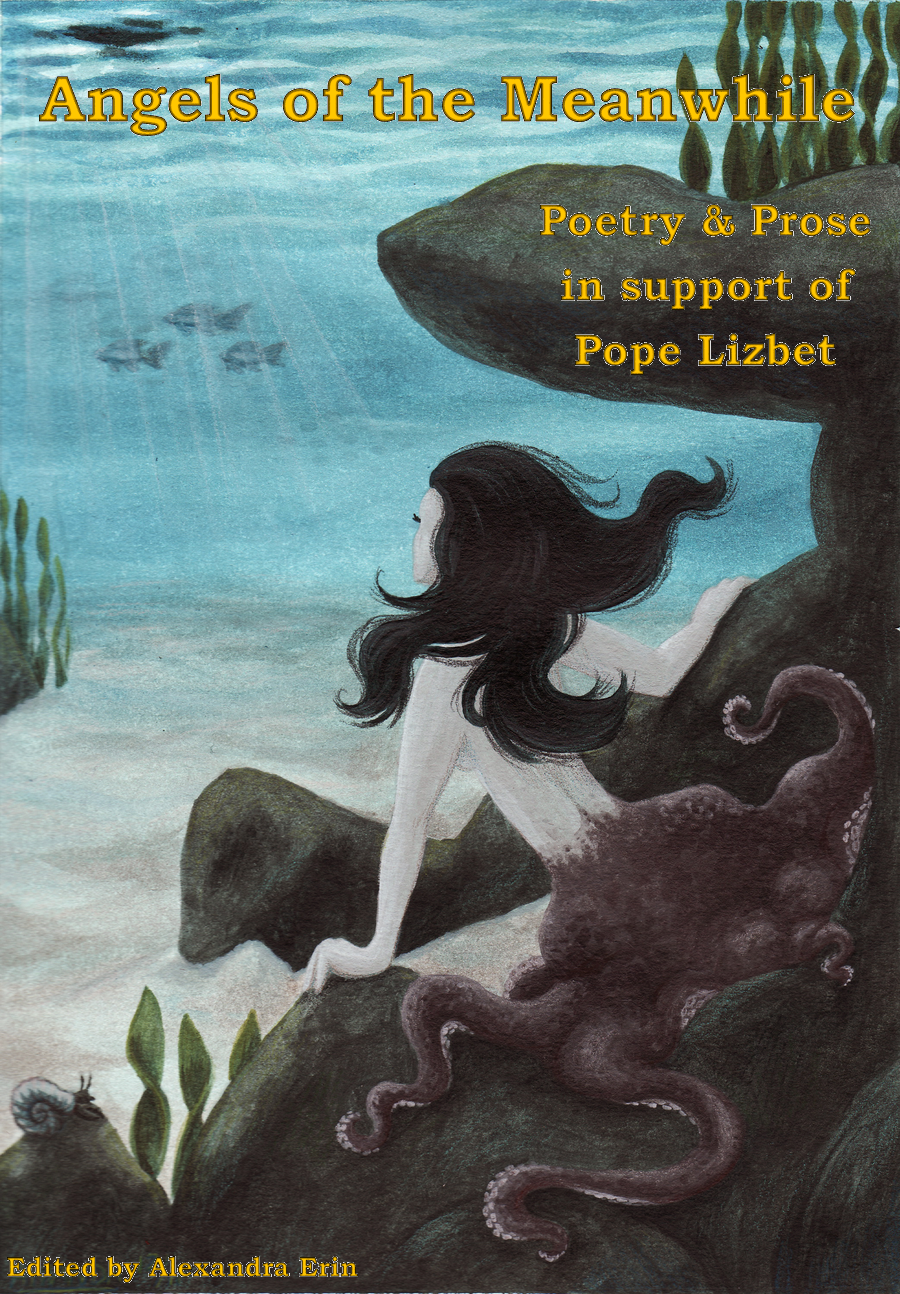
Next, since you’re here, I should mention the benefit anthology Angels of the Meanwhile, which contains works by many notable past and present members of the WisCon community. This project exists to benefit Elizabeth R. McClellan (aka @popelizbet), who is both the main reason I’m still writing and the only reason I started going to WisCon.

She suffered a serious injury in the course of avoiding an auto accident earlier this year, and the expenses and complications from that have spiraled. I have put together a collection of donated poetry and prose, some brand new and some previously published, from writers who are close to her or connected to a community she belongs to.

The only way to get this multiformat, DRM-free e-book, is to pre-order now by sending Lizbet a PayPal contribution in any amount you deem fair. All proceeds go directly to her, helping her out in a time of need.

And she does need help.


The initial response was good, and the caliber of talent involved is great, but… we really need more attention for this project in the next few days, and more pre-orders. I can’t help feeling like I am failing my dear firend here. Despite being successfully self-published, I’m actually not that great a promoter or networker. I’m shy, I don’t like to make waves or feel like I’m annoying people.

So please, check out Angels‘ amazing Table of Contents, make a contribution of any amount, share the link, and encourage others to do the same. We need more eyes on it.

I’ve got a lot of cool stuff coming up in the relatively near future, though an exact timeline is going to depend a bit on my health, so I’m not going to go into specifics just yet. For the next few days at least, this blog will probably be full of WisCon recaps/reflections/post-mortems.

The Puppies come so close to getting it, so often.

While reading the linked articles on Mike Glyer’s daily round-up of Puppy and Puppy-adjacent posts, I stumbled across a post by Dave Freer from February called “To Serve One Master — The Reader“.

The major thrust of the blog post is the idea that however an author intends a work to be received is secondary to how readers receive it, which… okay. This is something that it’s taken me a long time to accept as an author, but I have to say that I am in general agreement with it.

The thing is, it’s weird to see a self-professed Puppy saying this. After all, these are the same people who, whenever someone starts talking about the racist or sexist content of a work, respond with “BUT THAT’S NOT WHAT THE AUTHOR MEANT! YOU CAN’T KNOW WHAT’S IN THEIR HEARTS AND MINDS! YOU’RE JUST READING INTO THINGS!”

Of course, predictably, to the author of this blog post, “the reader” (also referred to as “the customer”) is a monolithic if not singular entity. “The reader” has a single set of tastes, which all authors are obliged to satisfy.

According to Dave Freer, its the people who remember what one commenter calls the “SHAZAAM!” factor of Star Trek who are Star Trek’s customers, not the people who appreciate the utopian social messages and the hope for the future, or the clever dialogue and rich characterization and interpersonal relationships, or any other aspect of the show.

According to Dave Freer, when people go to a movie that features a rich fictional culture and also laser battles, it’s the people who remember the laser battles (and only those people) that are the customers who deserve to be catered to.

Freer uses the piece to berate authors who don’t write for “the reader”/”the customer”, explicitly meaning consumers who want the sorts of things Dave Freer thinks consumers should want.

He advises writers:

Of course you can just hope they like your stuff. Or you can try and write what they want. Maybe slant it a bit in the direction that you want to communicate about. Of course if that slant fails to gain traction and overwhelms what they did want… you’ve lost. And, if they’re not a captive audience, they’ll find something they do like. … It’s really important to find out what customers want, and give it to them.

So a writer’s job is to figure out exactly what readers want to read and then give it to them? Yet when readers say they want more diverse books, or they want to read books with characters they can identify with, or they want to read books that don’t use real-life sources of trauma as set decoration, that’s “political correctness run wild” or “SJW thought police” or whatever buzzwords the Sad Puppies and their ilk want to string together today.

Why? Because the people who want to read those things aren’t readers. Only the people whose tastes and preferences are Dave Freer-approved are readers. To the Sad Puppies, an author’s job is to please the Dave Freers and William Lehmans of the world, not the K. Tempest Bradfords and David Gerrolds.

It’s really striking how often the Sad Puppies claim that “the other side” is all about dictating who is and isn’t “True Fans”, given how much of their rhetoric revolves around this kind of thing. It’s also striking how much this ideology overlaps with Gamergate.

Freer repeats a common Sad Puppy talking point, that SF/F is in some kind of death spiral because so many authors refuse to cater to “the reader”. This notion—insofar as it is based on anything—is based on the fact that in a diverse field where authors are free to write whatever they want that appeals to any audience (not just Dave Freer’s idealized concept of “the reader”), a market that would otherwise belong wholly to the lowest common denominators is instead spread out among more works.

The Puppies see this as a terrifying prospect, the end of the genre as we know it. Puppy standard-bearer Brad Torgersen, in his now-infamous “Nutty Nuggets” post (which might as well be subtitled “WHY CAN’T I JUDGE BOOKS BY THEIR COVER?”), lamented a future where SF/F is everywhere: SF/F romances, SF/F mysteries, et cetera.

I don’t know what the problem with that is.

Science fiction everywhere?

I call that winning.

It might be—I’m not in a position to know, but it might be—that the “fracturing” of the field in terms of more diverse voices writing for more diverse audiences is making it harder for the big publishing houses to churn out big blockbusters. I don’t know. But as an independent author, I don’t see much percentage in measuring the health of the genre by the performance of the biggest players only. I’d rather measure the field’s growth in terms of how many people are reading and writing science fiction vs. how many copies the most popular books sell.

STATUS: Thursday, May 28th

The State of the Me

Late yesterday, I began to exhibit symptoms of having picked up a case of the creeping con crud. This is the first time in a couple of years I have succumbed to such. The “good news” in all this is that since we were all sick here so shortly before the con, we already have some supplies on hand. The bad news is that I’m already in worse shape than I was during my previous bout, when I was hit less hard than anyone else in our family circle… and even that was enough to knock me on my back for a while.

The Daily Report

I went ahead and did a Sad Puppy Book Review this morning. I’m not sure it’ll be anybody’s favorite unless they’re familiar with the specific bit of Puppy-based criticism it’s parodying, but meh. It was necessary to get my hand back in after more than a week away from it. A short review that mostly spins off one particular line of criticism is about all I can manage right now, to be honest.

Plans For Today

I’m basically up and about right now so I can make sure that I eat actual food and drink something. After I’m done with lunch, I’m going to go lay back down. I might try to do some writing from bed later on.

Sad Puppies Review Books: GOODNIGHT MOON

goodnight moonGOODNIGHT MOON

Reviewed by John Z. Upjohn, USMC (aspired)

I suppose this book is supposed to be clever in that literary way that SJWs are so fond of, but I found it to be a confusing and unholy mess. It was very hard to follow. The prose was far too clunky and the signaling was all wrong. Good stories use signaling to tell you what kind of story they are, so you will know how the story goes and not be thrown out of it when something happens that you do not expect.

If a story opens in a tavern, you know somebody is going to go off on a sword-swinging fantasy adventure. If a story opens in a detective’s office, you know that a dame is going to walk in and she is going to be trouble. These stories are good stories.

The initial worldbuilding signals in Goodnight Moon were all for a story set backstage at a televised talk show. Right away in the first sentence we are told that it takes place in a green room, in “the great green room” so you know it’s not just a talk show but a good one. Then there’s a telephone, which is very sensible. The SJWs would never let me be on a talk show because they suppress my message at every turn, but I could believe there would be a telephone in the green room.

The next sentence is where they start to lose me. A red balloon? What does that have to do with being backstage at a television show? I had to go back to re-read the opening of the story a few times to make sure I had read it correctly, which is never a good sign. It turns out I had read it right after all, which meant the book was wrong. The red balloon was an unimportant and doubtlessly incorrect detail that could be ignored.

The next line breaks across the page, which just seems like bad editing to me especially since there was a picture on the facing page so you have to skip a whole page to find out how it ends. The picture included a young rabbit in bed staring at me in what I will characterize as an uncomfortable fashion. Between that and the unfinished sentence, I was in no hurry to study it further.

The next couple of pages simply describe the artwork on the walls of the green room. I began to form a picture of the main character, sitting idly in the waiting room of a talk show, waiting for his turn to be called out and interviewed by the host. What does he do? He looks around at the art that has been hung on the walls. The art is good, simple art. It shows cows and bears, not abstract concepts and feelings. This is going to be a conservative talk show, I decided. You can just tell.

Sadly this early promise is one the book promptly breaks, as the following pages reveal that the nonsensical addition of the red balloon was not a one-off mistake. The objects introduced include toy houses and mittens and random bowls full of mush, things I feel confident in saying would not be found in a green room.

About halfway through there is a major shift in tone. Before this the book had been concerned with introducing elements to set the stage. Right when I was sure the author must be done with all this world-building and build up, though, the book simply starts over, going back through the list of objects and saying goodnight to each of them.

Young writers, take note: this is not something you should do. The opening lines of your book forms a contract with your readers which you must not break. If you are clearly signaling in the first four pages that you are going to give them a story set around a conservative talk show, do not give them a mere bedtime story. This was so confusing I had to read back through the book several times to make sure I understood what had happened.

The mark of a good book in any genre is that you should be able to read it once, be satisfied that it did exactly what was promised, and then never read it again. You should almost not need to read it the first time. From the opening lines of Goodnight Moon I knew it was going to be about a man backstage at a conservative talk show, as surely as I know when I meet a liberal that he will start quoting Saul Alinksy chapter and verse at me.

This book was not up to the high standards I associate with storytime.

Two stars.

The State of the Me: The Post WisCon Post

Well, WisCon this year was excellent. I intend to write about specific aspects of it more fully in the near future, but this post is more about how I’m doing right now. As my Facebook friends and a couple of people I saw at the Madison airport already know, my homeward travels were anything but smooth.

I was actually pretty pleased with our itinerary. We were taking off at 6, which meant we didn’t have to go barreling out of the hotel and had a direct flight that would get us on the ground by nine, meaning that even with the commute back home to Hagestown we’d be there before midnight with very little in the way of either fuss or muss.

The long version’s not really worth recounting in full here. The short version is that our flight was delayed repeatedly and then canceled, and our choices were to stay overnight somewhere and try again tomorrow, or accept a non-direct flight with a tight connection through another airline that would have us on the ground close to 1 in the morning. Neither choice was ideal, but the first one wasn’t even workable.

We got in the door around 3:30 in the morning, after what had ended up being a longer, more stressful, and more physically demanding day than any of us had banked on.

Based on previous experience, I had planned on today mostly being recovery and reflection, but it’s wound up being more recovery than reflection. There may be more blog posts coming up today, and there may not be. Anything more “worky” is going to have to wait until tomorrow.


Of Dinosaurs, Legos, and Impossible Hypotheticals

A Super Serious Meditation on the Nature of Speculative Fiction

One of the squawking points that the Puppy campaigners keep returning to in their quest to prove the existence of a shadowy Social Justice Warrior cabal that at some point took over and subverted the Hugo awards (thus necessitating that they ride in as liberators) is the 2014 nomination of “If You Were A Dinosaur, My Love“, a quirky yet haunting and deeply emotive short story by Rachel Swirsky.

The Puppies, who only understand that tastes are subjective when it’s convenient for them, take it for granted that this story is so awful the only possible reason it could have been nominated was that the SJW clique was rewarding it for pushing the “proper” message.

I’ve never yet had a Puppy who was able to explain, when asked, exactly what the message was. Dinosaurs are more awesome and less frail than humans? Five men should not gang up on one person and savagely beat them with pool cues for being different? What’s the controversial hidden meaning of this story, exactly?

It’s worth noting that the Hugo voting community was and remains pretty sharply divided about this, and it did not win. So one must wonder what all the fuss is about, even if the story does not seem Hugo-worthy. Of course, some people might say that if it’s an honor just to be nominated, then it’s worth asking if the honor was earned… but the Puppies’ individual grievances suggest that they don’t see nomination as an honor. Both Torgersen and Correia’s Campbell nominations have been treated essentially as pledges that were not fulfilled, for instance, and Torgersen acts as though Mike Resnick’s nomination was an unforgivable snub.

But I don’t wish to focus too much on the Puppies’ problems with this story, because there are complaints against it that go beyond their borders. As I said, the community has been divided about its merits, if not as a work in general than as a speculative fiction story in particular. The common criticism amounts to the idea that it is neither a story nor SF/F.

My John Z. Upjohn’s review of If You Give A Mouse A Cookie actually plays on the logic of this: that since the whole story is inflected in the conditional case, nothing really happens within it. The narrator is not telling us what happened when the person referred to in the title was a dinosaur, but merely relating what might have happened if they were a dinosaur. So while the story is full of science fiction-y concepts (though it explicitly paints them as magical and thus fantasy, but more on that later), it’s not actually a specfic story—the reasoning goes—because none of that stuff actually happens.

As it happens, I can’t agree with this logic. I just can’t. “A text in which the narrator explains what would happen if something impossible according to our current understanding of the world happened” is a pretty decent definition of a speculative story to me. In fact, I’m not sure how it could be improved upon. If Rachel Swirsky had written an alternate version of the story that simply straight-out related the events being described as hypothetical in the extant version, they would be no less hypothetical and no more real, would they?

Speculative fiction consists of speculation; that is tautology. It answers the question “What might happen if this other, currently impossible thing happened?”

Swirsky’s story does a number of things worthy of discussion. Making the question explicit, making the speculative nature of speculative fiction part of the text rather than the subtext is simply one of them. If there’s any doubt that this skillful play on convention is not deliberate and informed, it should be laid to rest by the line which follows another impossible hypothetical introduced into the text, the line that reads:

all those people who—deceived by the helix-and-fossil trappings of cloned dinosaurs– believed that they lived in a science fictional world when really they lived in a world of magic where anything was possible.

In this line, Swirsky is commenting on the porousness of the boundaries we try to draw when it comes to speculative fiction. This is science fiction, that is fantasy; this has lasers and star ships, that has swords and sorcery. But even without getting into Arthur C. Clarke’s apt but perhaps overworked adage about sufficiently advanced science… the divide really isn’t as clear as all that.

So much science fiction never bothers to address the why or how of its hypotheticals, because the question the author wants to address isn’t (for instance) “How can we make autonomous intelligent beings to serve us?” but “What happens when we do?” Isaac Asimov’s “positronic brains” weren’t a prediction; he grabbed the most scienterrific buzzword available to him at the time and used it to explain the leap necessary to answer the question of “If We Were Robot-Makers, My Fellow Humans”.

So much of the annals of science fiction require us to imagine not just a new technological breakthrough but a specific breakthrough in our understanding of the physical laws of the universe, some principle hidden to actual real-world modern humans, which when mastered allows us to do things that seem like magic.

Similarly, there are certainly stories with fantasy trappings that dress them up with what Swirsky refers to as the “trappings” of science fiction: magic may be explained away by the wise as simply “subconscious psionic talents focused through the use of repetitive motions and chants”. Actually, I haven’t read all that much that takes that particular route, but it apparently is or was once a common enough meme that I’ve encountered readers who just assume that all well-written magic must be this, and are shocked at the idea that it might not be the author’s intent.

The point I am making here is that you can interpret nearly all of science fiction as fantasy and nearly all of fantasy as science fiction, which might be why we get so hung up on the “trappings”, on the limbs and outer flourishes. This story is science fiction because it has atomic blaster rays, or cyberspace, or nanites, according to your epoch. That story is fantasy because it has elves and dwarves and dragons. Sometimes we focus on the feel when drawing the dividing line. Even a grim and gritty science fiction story is not grim and gritty in quite the same way as a grim and gritty fantasy story, though exploring why would probably take a whole separate blog post.

This porous divide is not the major theme or focus of Rachel Swirsky’s work, and I’m not suggesting that it is only in her acknowledgment of it that the work achieves relevance or eligibility as a speculative fiction story. If talking about the nature of science fiction and fantasy made a work science fiction or fantasy, this blog post would count as speculative fiction. My point here is that there is a lot more going on in this brief piece than a “mere” chasing down of impossible hypotheticals.

But that “mere” is used advisedly, because that’s “merely” what science fiction and fantasy are.

There’s another work nominated this year that has stirred similar questions in a more limited way, perhaps more limited because the Dramatic Presentation categories are seen as less serious and crucial in a literary award than the literary categories, and perhaps because as a Sad Puppy pick it is taken less seriously to begin with.

The work in question is The Lego Movie, which contains a couple of scenes near the end that make explicit the implicit framing device for a movie about Lego characters in a world made out of Lego blocks: it’s all a child, playing with toys. It is this moment, in my opinion, that elevates The Lego Movie from merely being charming and fun to actually pretty sublimely brilliant. It explained so many of the odd quirks of characterization and storytelling earlier in the film.

I mean, it changed the movie’s version of Batman from “weirdly out of character, but okay, it’s funny” to “…that’s freaking brilliant” because it wasn’t Batman as adult comic book fans understand him but Batman seen through the eyes of a child, with way more focus on the cool factor of everything and of course he has the coolest girlfriend and of course even the grimdark angst seems kind of fun…

But that’s just one representative example. Taken as a whole, the movie reminded me of the way my brothers and I used to play with our toys, not playing with this set of characters or that but throwing them all together in an expansive world, some with the figures “playing themselves” and others being creatively repurposed.

We had one figure of a female character with green hair in a red body suit. I believe it was a Robotech character, but she often stood in for Samus Aran because we didn’t have a Samus action figure available to us, but if you unlocked the armor-less playthrough and had the Varia, Samus had green hair and a red body suit. These are the kinds of creative compromises a child’s imagination makes on the fly, and The Lego Movie nailed that.

Here’s the rub, though: a movie that is about imagination and how children play with toys isn’t speculative fiction in any meaningful sense, is it? The story that the little boy is creating for himself is both science fiction and fantasy, but the story about the little boy creating that story through play is rooted firmly in the real world, right? Anybody could do that.

Except during those scenes in the “real world”, the main character maintains his consciousness and a small amount of ability to move independently of the child. There’s no narrator relating this to us. The child is not aware it’s happening. The Lego Movie thus is a fantasy movie, because it contains this element of the unvarnished fantastical.

But look at what a whiplash, razor-thin calculation this is: if we had a cut of the movie that removed the main character’s internal monologue from the scenes taking place in the basement and replaced the character’s independent movement with being accidentally swept to the floor or something similar, the movie wouldn’t be fantasy anymore, yet if we removed those scenes entirely, it would be fantasy again?

I’m sorry, but I don’t buy it.

It’s far less ridiculous to simply declare that The Lego Movie is a fantasy movie than it is to say that it all hinges on the explicitness or lack thereof of a framing device.

To use some other examples:

The Wizard of Oz is a fantasy movie because the story we’re told from the moment that Dorothy is knocked out until the moment she regains consciousness is a fantasy movie; nobody went to the theater to see the amazing adventures of a young woman’s misfiring neurons, but her magical adventures in a land of wonder.

Big Fish is a fantasy movie because it contains a fantasy story; that this fantasy story is intertwined with a family drama makes it no less fantastical. The family drama keeps us grounded and invested, but no one went into that movie thinking, “Gee, I really hope that Billy Crudup reconciles with Albert Finney before he dies.” People might have thought that—or felt it, rather than explicitly having those words pass through their heads—while sitting there watching it, but that’s not why they showed up for it.

How about Edward Scissorhands? If you casually think about that movie, you might not even realize it has an explicit framing device. But the movie is explicitly a story we are being told, which means that any or all of the more impossible, unlikely, and phantasmagorical elements of the story might be imagined or exaggerated or just plain fabricated. The whole thing could be another “Big Fish” story.

Then there’s The Princess Bride. The heartwarming story of Columbo bonding with Wonder Years over a beloved classic story is important, sure. It adds an inflection to the other story, the story that he tells.

But when you get right down to it, what’s the difference between a fantasy story the movie tells to you directly and one the movie tells by means of addressing it to a character within the movie? Not much, by my reckoning. I’m not saying it’s not an important creative decision. The Princess Bride, The Lego Movie, and Big Fish would all be very different movies without their explicit frames. It’s hard to imagine them not being worse movies.

But every movie—every story—has at least an implicit frame. Even if a text is written in third person omniscient style with the least discursive and obtrusive voice possible, we are still being told this happened and that happened and he thought this and she said that and they did this thing. Convention dictates that an invisible narrator presented without appreciable personality or agenda should be fairly reliable, but what does “reliable” mean when we’re told the story of a thing that never happened and never could?

The lover of the narrator in Rachel Swirsky’s story never was a dinosaur, yes! And Han Solo never flew the Millennium Falcon. Captain Janeway never tricked the Borg Queen and returned to the Alpha Quadrant. Link never reunited the Triforce. These things are all both fictional and also impossible.

If you subscribe to the more SFnal-friendly versions of the multiverse theory (or to borrow the trappings of the other genre, the “all stories are true” theory of The Sandman), then of course these things did happen, somewhere, somewhen, somehow.

There is a world where Han Solo exists. In fact, there are infinite numbers of worlds in which he existed, which means that not only are there worlds in which he didn’t shoot first, there are worlds in which a trusting and slow Han Solo was shot dead by a cagey Greedo, and there are worlds in which Han Solo never owed money to Jabba because he was a vapor farmer instead of a spice smuggler.

So even allowing that there is a “real” world of Star Wars somewhere out there doesn’t let us say with any certainty or authority that any cut of a Star Wars movie or any particular of its expanded universe is “what really happened”.

All that we have in any SF/F story is the story, not the story of what really happened, just the story, or maybe more accurately, a story.

If we can imagine that any SF/F story we tell each other might be happening somewhere, we can imagine the same is true that any such story told within any story we’re telling each other.

The Great Speculative Fiction Multiverse not only demands we imagine that there actually a world where a little boy played out his frustration with his too restrictive dad using the world’s most amazing Lego set, it demands we imagine a world where conscious and autonomous Lego figures lived out that story. This demand does not change when we tell these two stories in proximity to each other, does it?

The distinction between “speculative fiction” and “not speculative fiction” is important, sure, but at the end of the day I’d say that the nature of the boundary is more something interesting to explore than necessary to pin down.

And I don’t need to know exactly where the dividing line between “fantasy” and “non-fantasy” lies to know that a story in which the narrator explains what might happen if a human being could magically transform into a human-sized T-rex is a fantasy story.
Angels of the Meanwhile goes to #WisCon39 (TEN DAYS LEFT)

angels of the meanwhile coverHey, folks! I’m Alexandra Erin, author of Tales of MU, Sad Puppies Review Books, and that blurry screenshot of a Tumblr post where Superman is singing to Batma that you saw on Facebook that one time.

Can I tell you a secret? I’m terrible at self-promotion. It’s my greatest weakness as an independent author. I’m lousy at networking, I just hate putting myself out there, I’m always worried that I’m making a nuisance of myself, that I’m annoying people, that what I’m doing is not good enough to call attention to…

Right now I’m at WisCon, and I’m doing my best to get over it because there are just ten days left to reserve your copies of Angels of the Meanwhile, an electronic chapbook of poetry and prose put together by caring friends to help Elizabeth R. McClellan (@popelizbet) with the unexpected medical expenses from the shoulder injury that has kept her from joining us.

I would not be here in Madison if she had not come first and then dragged me along with her the next year. I first met many of the people who have contributed their words to the collection here, too: people like the inimitable Amal El-Mohtar, the incomparable Saira Ali, and the unstoppable C.S.E. Cooney. Later today I’m going to be on a panel with the celebrated author and poet Ellen Kushner, who has also generously contributed a piece. Many of the other contributors are part of the larger WisCon community

The whole long list of authors and poets who have stepped up to contribute both new and previously published works is both astonishing and humbling. You can find the table of contents here, though there are also a few late additions I’m still slotting in. All the works listed there and more can be yours. How? Just make a payment in any amount you deem fair in the PayPal form below, and the money will go directly to Lizbet, helping her recoup out-of-pocket medical expenses, lost income, and other related losses from her shoulder injury.

Email Address (For Delivery)

When we’ve finished editing and formatting the final manuscript (projected for July), you’ll receive a package in your email containing the collection formatted for Kindle as well as Nook and other e-readers, and as a PDF. No e-reader? There are free apps for the e-book formats, and the PDF is readable on any computer or smart device.

We’re taking this pre-order route in order to give Lizbet the immediate financial relief she needs while still delivering a product equal to your gift and worthy of the talent that has been contributed to the cause.

Thank you for your help!

Hello, WisCon!

So, today we leave for Madison, one day earlier than planned. We won’t necessarily be at the Concourse before tomorrow… that depends on how we feel after a day of traveling, following closely on the heels of a day of panicky, last minute packing and preparations.

If you’re going to be at the Con and you want to say hi and/or hang out, here’s what you need to know:

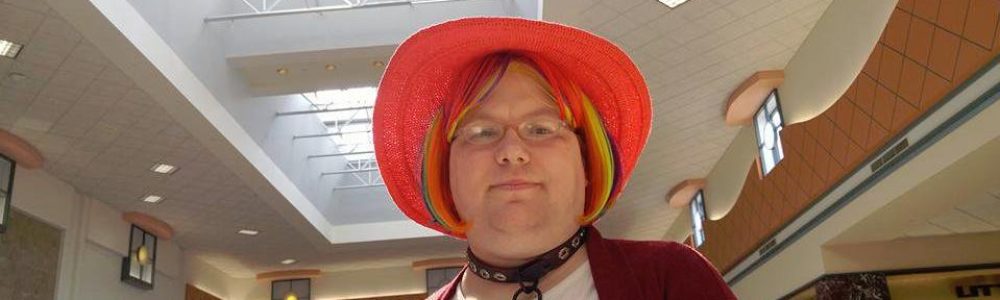
  1. Because I have a high degree of face blindness myself, I have a habit of making myself recognizable, especially at the con. My trademark rainbow fringe is actually a style I adopted specifically for WisCon two years ago. Depending on when you see me, I might have black hair with rainbow bangs or full-on rainbow hair. I won’t necessarily be the only person with rainbow hair, but the combination of rainbow hair, a floppy black hat, and a floor-length skirt are pretty distinctive.
  2. A thing I hear from people quite often is “I wanted to say hi, but you looked tired/sad/lost in thought.” I assure you, that is just my face. I mean, I might be tired. I have a chronic fatigue condition so I’m often tired. But if I let that stop me from having a good time, I would never have one. I am not the most social person in the world, but once a year I fly hundreds of miles and spend hundreds of dollars to meet people and be social. Help me get my money’s worth!
  3. The face blindness thing is real. If you do come up to say hi, please introduce yourself and please tell me if we’ve met before. I mean whether or not we have. Like, “Hi, my name is Connie Wisconsinconson. We’ve never met, but I wanted to say hi.” The reason I ask this is because if someone comes up and says hi to me, in most contexts this means we know each other and ordinary social norms require me to pretend I recognize them while I silently try to figure out who the heck they are. At con, I’m more likely to say fudge it and explain that I don’t recognize faces, because people are more likely to understand it.
  4. Name tags make things easier, but understand that even if I see you multiple times during a day, I will probably be scoping your tag each and every time. So far WisCon is the one place where I’ve had to do this that no one has been noticeably offended by it, but just letting you know.
  5. I am jumpy when touched unexpectedly. I do enjoy hugs, with sufficient warning.

And that’s about it. I am on a boatload of panels and my boyfriend Jack is also on panels for the first time and I’d like to support him when I am able to do so, so my schedule is not going to be terribly flexible, but seriously, if you want to say hi, say hi.

UPDATE: WisCon and more.

Okay, big whoops, caught at what was almost the last possible moment where it could still be fixed, but still caught: when I booked our flights for WisCon, I put in the wrong date. We were planning on getting there Thursday the 21st, but I selected Wednesday the 20th. As in, tomorrow.

I guess that explains why the cost was unexpectedly reasonable for ~1 month in advance… it was that much farther away from the weekend.

At this point, it was impossible to change the tickets at anything like a reasonable cost, so the “fix” means just going with it and getting into Madison a day early. Sadly, the con hotel is fully booked for Wednesday, so they could only put us on a waiting list with no promises. Plan A was to stay on the waiting list while seeing if any of the people we know who are local to Madison could give us crash space.

After reflection, though, I decided that trying to find trans-friendly accommodations (preferably with someone we know) on 24 hours notice as a hedge against the wait list not coming through wasn’t a great idea, especially as everybody we know in the Madison area is going to be busy and/or already hosting guests for the con. The real kicker is the short notice thing… travel is already stressful, and we’re going to be doing it with 24 hours less lead time than we had been counting on.

So I bit the bullet and reserved us a room for one night at the hotel around the corner, the Inn on the Park. I know where it is, I’ve seen the inside, I know the logistics of getting luggage from there to the Concourse on foot, it’s in the one part of town that we know.

An extra night in a hotel plus another day of eating out will put a bit of a dent in our budget, but I think it’ll be worth it to not have to worry about logistics and uncertainty when we land. We can just shuttle from the airport more or less like normal, probably have a quiet night in, and be at WisCon central brighter, earlier, and more fresh-faced than we’d planned.

This change is going to have a pretty huge impact on my work week, though… as you might have imagined, I’ve spent the whole afternoon since I learned of my error running around trying to get trip preparations done. Between that and the fact that we’re leaving tomorrow… I don’t know what’s going to happen with Tales of MU this week. Part of it depends on how much quality writing I’m able to do with the rest of this afternoon, after having run around like a chicken with its head cut off.

I will do my best to keep you all posted.